
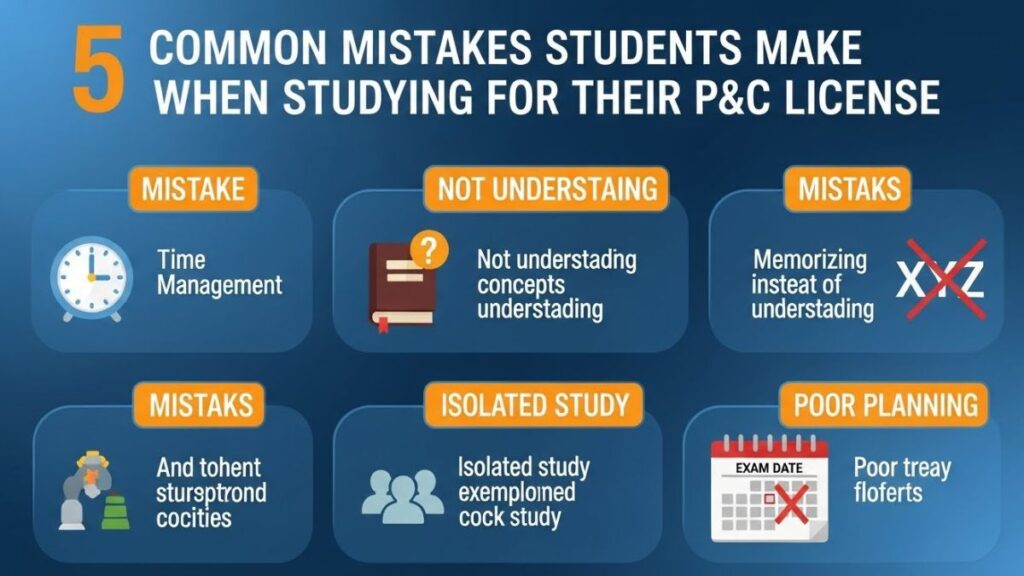
Preparing for the Property and Casualty insurance license exam can be challenging. Every year, thousands of aspiring insurance professionals sit for this exam, and while many pass on their first attempt, others struggle due to avoid study mistakes. Understanding these common mistakes can make the difference between walking out of the testing center with confidence or having to reschedule for another attempt.
1. Underestimating the Exam’s Scope and Difficulty
One of the most critical errors students make is assuming the P&C exam will be straightforward because they have prior insurance experience or because they have passed other professional exams. The reality is that the Property and Casualty license exam covers an extensive range of topics, from policy provisions and coverage types to state-specific regulations and insurance law.
Many students report feeling blindsided by the depth of knowledge required. The exam does not just test your ability to memorize definitions, it evaluates your understanding of how different insurance concepts interconnect and apply to real-world scenarios. Questions often present complex situations requiring you to apply multiple concepts simultaneously.
Students need to start preparation early, with realistic expectations and under the guidance of experienced instructor. A comprehensive texas insurance license exam preparation should guide students through both national and state-specific content systematically. Student need to prepare at least 1 week of dedicated study time, even if you have industry experience.
2. Relying Solely on Passive Learning Methods
It is necessary to actively engage with the material and understand the concepts rather than just reading the course content. Students often spend hours highlighting textbooks or watching instructional videos without testing their comprehension or ability to recall information.
123AceTheTest provides online classes of property and casualty where experienced instructors engage with students and ask questions to ensure comprehension and active participation throughout the learning.
3. Neglecting State-Specific Regulations
The P&C license exam isnot just about general insurance principles, it includes a significant portion dedicated to your specific state regulations, laws, and requirements. Many students focus heavily on the national portion of the exam and give insufficient attention to state-specific content, only to be caught off guard by detailed questions about local regulatory requirements.
Each state has unique rules regarding policy provisions, filing requirements, consumer protections, and licensing procedures. For example, Texas has specific regulations about windstorm insurance, TWIA (Texas Windstorm Insurance Association), and surplus lines insurance that differ from other states.
4. Cramming Instead of Spacing Out Study Sessions
In fast-paced world, many students try to compress their exam preparation into a few intensive study marathons right before the test date. While cramming might have worked for some college exams, it is particularly ineffective for comprehensive professional licensing exams that require deep understanding and long-term retention.
Cognitive science research consistently shows that spaced repetition—studying material over multiple sessions separated by time—leads to significantly better retention than massed practice (cramming). When you space out your learning, your brain has time to consolidate information, creating stronger and more durable memories.
Additionally, cramming often leads to mental exhaustion right before the exam, when you actually need to be at your sharpest. Students who cram typically experience higher test anxiety because they’re acutely aware they haven’t adequately prepared.
Instead, create a realistic study schedule that spreads your preparation over several weeks. Study infocused45-60 minute sessions with breaks, rather than marathon 4-5 hour blocks. Review previously studied material regularly, even after you think you’ve mastered it. This repeated exposure over time strengthens retention and helps move information from short-term to long-term memory.
5. Ignoring Practice Exams and Performance Analysis
Many students wait until the last minute to take practice exams, or skip them altogether. This is a missed opportunity! Practice exams are essential for familiarizing yourself with the exam format and question style, identifying knowledge gaps, building test-taking stamina, and easing anxiety by making the actual exam feel more manageable.
What you do after taking a practice exam is just as important. Avoid merely checking your score and moving on. Analyze your performance: Which topics were challenging? What types of questions gave you trouble? Did you manage your time well? Reflecting on these factors will provide you with valuable insights that can guide your subsequent study sessions.
At 123AceTheTest, we are committed to helping you prepare effectively for your Property and Casualty license exam. By steering clear of these common mistakes and following a structured approach, you can set yourself up for success. Happy studying!