
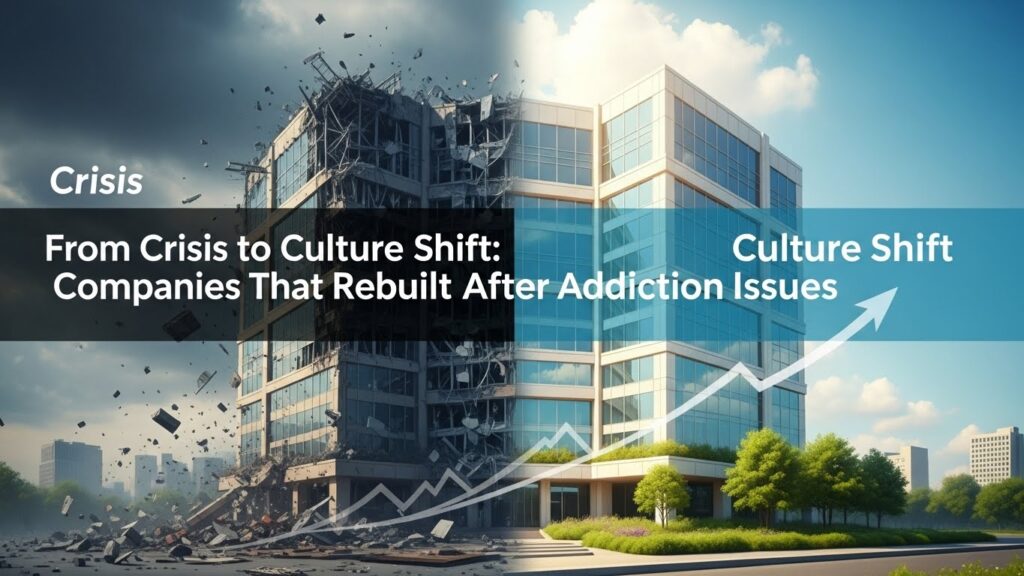
Most organizations do not plan to confront addiction-related crises. When they arise—through leadership breakdowns, safety incidents, reputational damage, or widespread burnout—the instinct is often to contain the issue quietly and return to normal as quickly as possible.Yet the companies that emerge strongest are rarely the ones that simply “move on.” They are the ones that use crisis as a catalyst for deep cultural transformation—rebuilding systems, leadership behaviors, and values in ways that make recurrence less likely and performance more sustainable.
This is not about redemption narratives. It is about organizational learning under pressure.
The Crisis Moment: When Denial Stops Working
Addiction-related crises tend to surface after prolonged warning signs:
- Leadership volatility or ethical lapses
- Safety or compliance failures
- High turnover paired with burnout
- Repeated “one-off” incidents that form a pattern
By the time a crisis becomes unavoidable, organizations are often operating in damage-control mode. What differentiates outcomes is not the severity of the incident—but how leadership interprets it.
Companies that fail see addiction as an anomaly to isolate. Companies that rebuild recognize it as a systemic signal.
The Common Thread in Successful Rebuilds
Across industries—technology, manufacturing, finance, healthcare—organizations that rebuilt successfully after addiction-related crises shared several characteristics:
- They stopped framing the issue as purely individual
- They accepted cultural and structural responsibility
- They committed to long-term change, not cosmetic fixes
This shift in framing is the foundation of culture change.
Case Pattern 1: Leadership Accountability Replaces Silence
In organizations that rebuilt trust, leadership addressed the issue directly—without oversharing, but without evasion.
This often included:
- Clear acknowledgment that leadership behavior or systems contributed to risk
- Temporary or permanent leadership restructuring where needed
- Independent reviews of decision-making, workload, and accountability gaps
- Explicit separation between compassion and exemption from standards
Employees consistently report that clarity restores trust faster than secrecy, even during difficult transitions.
Case Pattern 2: Policies Were Rewritten Around Reality, Not Ideal Behavior
Post-crisis organizations moved away from policies designed for “perfect employees.”
Instead, they implemented frameworks that acknowledged human limits:
- Recovery-aware return-to-work policies
- Clear performance expectations paired with support pathways
- Manager training on early intervention and behavioral health response
- Confidential access to external support resources
These policies were not permissive—they were practical. And they reduced future risk by encouraging earlier disclosure and intervention.
Case Pattern 3: Performance Culture Was Redefined
One of the most profound changes occurred in how performance was defined.
Before crisis:
- Output was rewarded regardless of sustainability
- Availability signaled commitment
- Burnout was normalized
After rebuild:
- Consistency mattered more than intensity
- Decision quality was valued over speed
- Boundaries became leadership competencies
- Recovery and rest were framed as performance enablers
This reframing reduced relapse risk, turnover, and operational volatility.
Case Pattern 4: Managers Became Culture Carriers, Not Bystanders
In companies that rebuilt successfully, middle management played a critical role.
Organizations invested in:
- Training managers to recognize early warning signs
- Giving managers clear escalation pathways
- Removing fear around “saying the wrong thing”
- Reinforcing that inaction was a leadership failure
This prevented future issues from bottling up at the team level.
Case Pattern 5: Psychological Safety Was Rebuilt Intentionally
Trust does not automatically return after crisis. Rebuilt organizations treated psychological safety as a strategic priority.
They focused on:
- Consistent enforcement of standards across roles
- Clear communication during and after change
- Zero tolerance for stigma, gossip, or retaliation
- Visible alignment between stated values and leadership behavior
As safety increased, engagement and retention followed.
What These Companies Did Not Do?
Equally instructive is what successful rebuilds avoided:
- They did not rush to restore “business as usual”
- They did not rely solely on HR or legal containment
- They did not isolate the issue to one individual
- They did not treat culture change as a branding exercise
Culture shifted because systems shifted—not because messaging improved.
The Measurable Outcomes of Culture Shift
Organizations that rebuilt after addiction-related crises commonly reported:
- Improved retention of high-performing talent
- Reduced burnout and absenteeism
- Stronger leadership bench depth
- More consistent decision-making under pressure
- Lower long-term legal and reputational risk
In several cases, post-crisis cultures outperformed pre-crisis environments precisely because denial had been removed.
Why Crisis Creates Opportunity for Real Change?
Most organizations struggle to justify deep cultural reform during periods of growth. Crisis removes that resistance.
Addiction-related crises expose:
- Where accountability breaks down
- Which behaviors are tolerated despite stated values
- How pressure is mismanaged
- Where leadership capacity is overstretched
When addressed honestly, these insights become blueprints for healthier systems.
Culture Shift Is a Leadership Decision, Not a Program
The companies that rebuilt did not delegate culture change to task forces alone. Senior leadership owned it visibly and consistently.
Culture shifted because leaders:
- Changed how they made decisions
- Modeled boundaries and accountability
- Acted early instead of waiting for proof
- Prioritized long-term stability over short-term optics
Employees followed behavior—not slogans.
Conclusion: Crisis Does Not Define a Company—Response Does
Addiction-related crises are painful, disruptive, and costly. But they do not have to be fatal.Companies that rebuild successfully understand one core truth: crisis reveals culture; it does not create it.
When organizations use that revelation to redesign systems, redefine performance, and restore integrity, they often emerge stronger, more resilient, and better aligned with the realities of modern work.The shift from crisis to culture is not automatic. It is a choice—made one decision at a time.And the companies that choose it rarely regret it.