
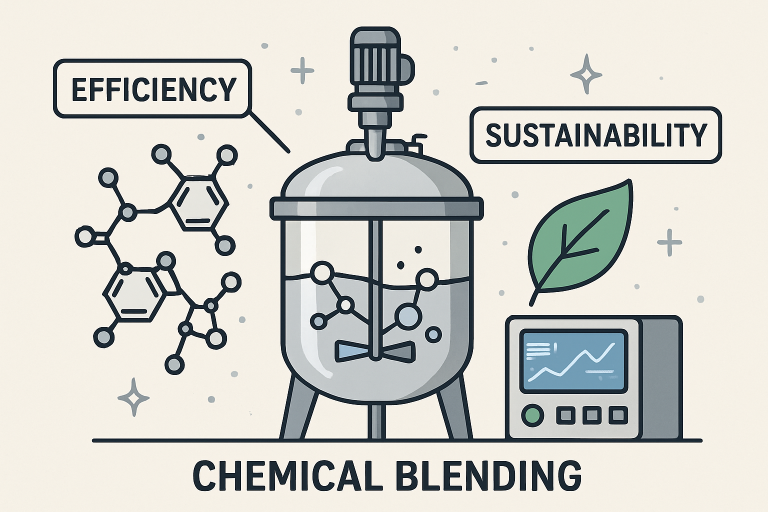
The chemical industry is undergoing rapid transformation, driven by innovative blending techniques that are fundamentally redefining how companies operate. The field is seeing significant gains in both production efficiency and sustainability through cutting-edge catalyst development, powerful data analytics, and eco-friendly synthesis methods. For example, recent improvements in industrial mixer for chemicals technology have opened new doors for manufacturers, allowing for more precise formulations and greater control over the mixing process. These refined processes enable large-scale production while delivering greater consistency between batches. By minimizing waste and maximizing product quality, these technological upgrades are also instrumental in driving down operational costs and reducing environmental footprints across a wide array of chemical sectors.
In today’s market, chemical firms must balance reducing environmental impact and controlling costs. Stakeholders and regulators demand transparency, greener practices, and sustainability. As a result, companies invest in new blending technologies to meet regulations and drive product innovation. These strategies help firms deliver value, stay ahead of industry standards, and adapt to changing market demands. Focusing on efficiency and sustainability enables the chemical industry to address global supply chains, climate change, and evolving customer expectations.
Zeolite Blending Methods
One of the most exciting developments in chemical blending is the advancement of specialized zeolite techniques. Zeolites, crystalline aluminosilicate minerals with high surface areas and specific pore structures, are widely used as catalysts in petrochemical and environmental processes. Recent research has increased the aluminum content in CON-type zeolites by blending multiple precursors, giving improved control over their functionality and selectivity. This progress supports the production of cleaner fuels, enhances feedstock conversion, and reduces energy consumption and emissions in pollution management. As the need for efficient catalysts increases, these innovations underscore the importance of continuous material development to boost efficiency and foster more sustainable industry practices.
AI Integration in Chemical Blending
AI is revolutionizing chemical blending by leveraging large datasets to enhance operational efficiency, quality control, maintenance forecasting, and real-time process adjustments. U.S. manufacturers experience up to 10% efficiency improvements. Additionally, AI monitors resource consumption, decreases waste and emissions, and boosts safety and regulatory compliance. This transformation leads to greater product consistency and fewer disruptions in a highly competitive industry.
Photoenzymatic Processes
An emerging trend at the intersection of sustainability and efficiency is the adoption of photoenzymatic processes in chemical manufacturing. This approach combines natural enzyme selectivity with light energy to drive specific reactions under milder, more eco-friendly conditions than traditional methods, which often require high temperatures, strong acids, or heavy metals. For instance, synthesizing complex organofluorine molecules, key in pharmaceuticals, agriculture, and polymers, can now be done more precisely with this technology. Using light and enzymes lowers energy use, reduces hazardous by products, and supports circular, resource-efficient processes. These photoenzymatic methods are gaining attention as a way for companies to decarbonize manufacturing while maintaining innovation and scalability.
Mechanochemistry in Pharmaceuticals
Mechanochemistry is making significant strides as a transformative, low-waste, high-efficiency alternative to conventional solvent-driven synthesis in pharmaceutical manufacturing. The essence of mechanochemistry lies in using mechanical force, such as grinding, shearing, or milling, to drive chemical transformations, thereby sidestepping the need for copious solvent use. This solvent-free approach is especially attractive for the pharmaceutical industry, where the cost and environmental burden of solvent recovery or disposal have long been a challenge. Mechanochemical techniques are proving especially powerful for synthesizing active pharmaceutical ingredients (APIs) and specialty intermediates, making the overall production process faster, cheaper, and cleaner. The simplification of purification steps, the reduction of toxic byproducts, and lower overall energy requirements support the industry’s ongoing shift toward greener, more sustainable processes. Furthermore, mechanochemical reactors can be scaled up with relatively modest investment compared to traditional process equipment.
Nanotechnology Integration
Nanotechnology is becoming increasingly important in advancing chemical blending technologies through the use of engineered nanoparticles. These innovations enhance the properties of materials for both manufacturers and end users. In the pharmaceutical industry, nanoemulsions and encapsulated drugs significantly improve bioavailability and enable targeted delivery, leading to safer therapeutic options. Additionally, silica nanoparticle-reinforced emulsions are more stable, helping reduce phase separation and extending shelf life. By precisely controlling nanoparticle characteristics, formulators can create high-performance products that elevate industry standards and promote efficient, eco-friendly manufacturing practices.
Conclusion
The advances in chemical blending outlined above are revolutionizing the industry’s efficiency and sustainability. From innovative zeolite engineering and AI-driven process optimization to greener synthesis routes like photoenzymatic catalysis, plus the adoption of cutting-edge nanotechnology applications, today’s chemical companies have a diverse toolbox for tackling tomorrow’s challenges. Embracing these new approaches not only ensures timely compliance with regulatory requirements but also positions organizations for long-term growth and resilience. In an era marked by intense competition and increasing scrutiny of corporate environmental impacts, the willingness to adopt forward-looking blending practices may become the hallmark of industry leadership and market success.