
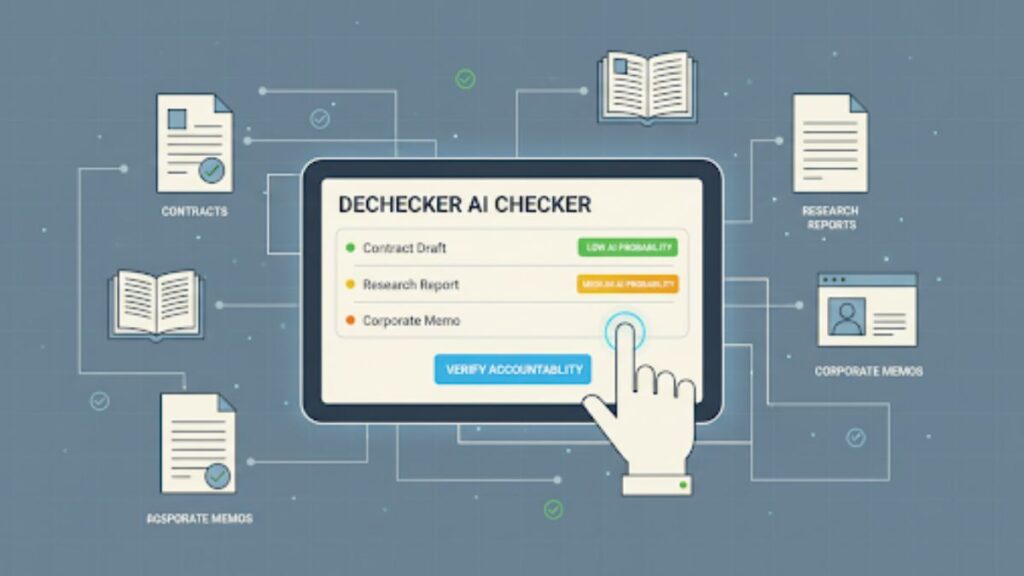
AI-generated text is no longer confined to experimental drafts or side projects. It now appears in contracts, research summaries, policy documents, and customer-facing communication. As organizations rely on language models more deeply, a new challenge emerges: understanding who, or what, is responsible for the final text that circulates inside and outside the organization.
Why Text Accountability Has Become a Strategic Issue
When Authorship Is No Longer Obvious
In traditional workflows, authorship was implied. A document reflected the expertise, intent, and responsibility of its writer. With AI-assisted writing, that assumption breaks down. A single document may combine prompts, model output, and human revision, making origin difficult to trace.
An AI Checker introduces visibility at this critical point. Instead of guessing how text was produced, teams can ground decisions in observable signals about AI involvement.
Accountability Gaps Grow With Scale
As content volume increases, small ambiguities become systemic risks. One unclear document is manageable. Hundreds across departments are not. Without detection, organizations often discover AI overuse only after issues arise, such as tone inconsistency, factual drift, or compliance concerns.
Detection shifts accountability upstream, allowing teams to address uncertainty before publication or distribution.
Responsibility Without Blame
Accountability does not require punishment. Most organizations encourage responsible AI use. The problem arises when AI contributions are undocumented or misunderstood. Detection supports transparency, enabling teams to clarify process rather than assign fault.
This framing is essential for long-term adoption.
How Dechecker Supports Text Accountability in Practice
Detection as an Insight Layer
Dechecker is typically used as an analytical layer rather than a gatekeeping mechanism. Editors, reviewers, or managers run checks to understand text characteristics, not to block progress automatically.
Because the AI Checker operates quickly, it fits naturally into review cycles without introducing friction.
Interpreting Probability Rather Than Labels
Text generation exists on a spectrum. Dechecker reflects this reality by offering likelihood-based assessments. These signals help reviewers decide whether additional context, disclosure, or revision is appropriate.
This probabilistic approach avoids the false certainty that often undermines trust in detection tools.
Coverage Across Major AI Models
Dechecker analyzes linguistic patterns associated with widely used systems such as ChatGPT, GPT-4, Claude, and Gemini. The focus is not on exposing technical detail, but on producing signals that remain meaningful for non-technical decision-makers.
Adaptability matters more than rigid classification.
Accountability Across Different Organizational Contexts
Legal and Compliance Documentation
In regulated environments, documentation must meet strict standards. AI assistance can accelerate drafting, but undocumented automation introduces legal ambiguity. Detection helps compliance teams understand where AI influence may require disclosure or additional review.
Here, the AI Checker acts as a safeguard rather than an obstacle.
Corporate Communications and Public Messaging
External communication carries reputational weight. Audiences expect clarity and authenticity. When AI-generated phrasing dominates public-facing text, tone can drift subtly but noticeably.
Detection allows communication teams to recalibrate language before publication, preserving trust without abandoning efficiency.
Academic and Research Outputs
Research integrity depends on traceability. Detection helps reviewers distinguish between original analysis and AI-assisted synthesis. This distinction supports fair evaluation and transparent methodology.
In academic settings, the AI Checker becomes a tool for proportional oversight.
AI Detection Within Modern Content Pipelines
From Raw Input to Refined Output
Many workflows begin with unstructured input. Meetings are recorded, interviews captured, or lectures archived. These materials are often converted using an audio to text converter, then refined with summarization or generative rewriting tools.
Detection at later stages clarifies how far text has moved from its original source, supporting responsible reuse.
Supporting Review Without Slowing Production
High-output teams cannot afford heavy manual checks. Detection provides a scalable alternative, surfacing potential concerns without interrupting flow. Reviewers focus effort where signals indicate higher AI involvement.
This targeted attention improves efficiency and consistency.
Aligning Detection With Policy Frameworks
Detection works best when aligned with internal guidelines. Results inform how policies are applied rather than replacing them. This keeps decision authority with humans while leveraging automated insight.
Dechecker fits into governance structures without redefining them.
What Makes an AI Checker Useful Over Time
Stability Across Text Types
Organizations handle diverse content, from short summaries to long analytical reports. Detection must remain reliable across formats and lengths. Inconsistent behavior erodes trust quickly.
Consistency is what transforms occasional checks into routine practice.
Interpretability for Real Decisions
Scores alone are insufficient. Reviewers need to understand what detection results imply in context. Dechecker emphasizes clarity so teams can decide on next steps, whether that means revision, disclosure, or approval.
Interpretability turns detection into a practical decision aid.
Continuous Adaptation
Language models evolve rapidly. Detection tools must evolve as well. Dechecker prioritizes ongoing updates to reflect changes in model output styles, ensuring relevance beyond short-term accuracy benchmarks.
Long-term usefulness depends on adaptability.
From Detection to Organizational Maturity
Building a Shared Understanding of AI Use
Over time, detection results reveal patterns in how teams rely on AI. This insight supports training, guideline refinement, and more effective collaboration between humans and models.
The AI Checker becomes part of organizational learning.
Reducing Risk Without Restricting Innovation
Unchecked AI use introduces uncertainty, while excessive restriction stifles progress. Detection enables balance by making AI involvement visible rather than hidden.
This balance is essential for sustainable operations.
Trust as an Operational Outcome
Transparency builds trust internally and externally. Organizations that can explain how text is produced are better positioned to meet stakeholder expectations. Detection tools provide the evidence that supports those explanations.
Trust becomes a byproduct of clarity.
Conclusion
As AI-generated text becomes embedded in everyday work, accountability emerges as a defining challenge. The question is no longer whether AI is used, but how clearly its role is understood. A capable AI Checker restores visibility in complex writing workflows, supporting informed decisions at scale.
Dechecker offers a pragmatic approach to AI detection by focusing on interpretability, adaptability, and workflow compatibility. For organizations navigating the evolving landscape of AI-assisted writing, tools that clarify responsibility rather than obscure it will define the next stage of maturity.