
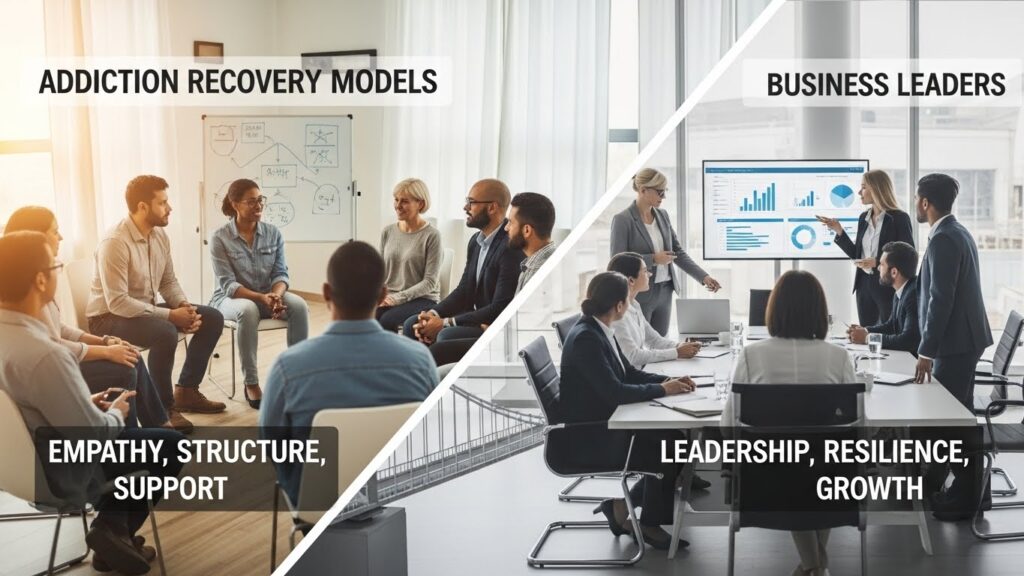
Addiction recovery models were not designed for boardrooms or executive teams. Yet, they address many of the same challenges leaders face every day: sustained pressure, accountability under stress, behavior change, long-term resilience, and ethical decision-making.While business frameworks often focus on performance optimization, recovery models focus on human sustainability.
The overlap between the two is far greater than most organizations realize.
Leaders who understand and apply these principles often build more resilient teams, make clearer decisions, and create cultures that perform consistently rather than episodically.
Recovery Models Are Built for Long-Term Change, Not Short-Term Wins
Most recovery frameworks are grounded in one core assumption: lasting change requires systems, not willpower.
This directly contrasts with many business cultures that celebrate individual endurance, heroics, and constant output. Recovery models instead emphasize:
- Structure over motivation
- Consistency over intensity
- Process over personality
- Progress over perfection
For business leaders, this reinforces a critical lesson: sustainable performance is not achieved through pressure alone, but through systems that support repeatable success.
Accountability Without Shame
One of the most misunderstood aspects of recovery is accountability. In effective recovery models, accountability is firm—but not punitive.
Key principles include:
- Responsibility for actions without personal condemnation
- Clear acknowledgment of impact on others
- Commitment to corrective behavior rather than punishment
- Ongoing self-assessment and course correction
In leadership contexts, this approach fosters ownership without fear. Teams are more likely to surface problems early when accountability is not paired with humiliation or retaliation.
Self-Awareness as a Leadership Skill
Recovery places significant emphasis on self-awareness—recognizing triggers, limitations, and behavioral patterns before they escalate.
For business leaders, this translates to:
- Understanding how stress affects decision-making
- Recognizing emotional reactions under pressure
- Identifying blind spots before they harm teams or strategy
- Knowing when to pause rather than push
Self-awareness is often framed as a soft skill. In reality, it is a risk-management tool.
The Power of Clear Boundaries
Recovery models are explicit about boundaries. They recognize that unchecked access, overextension, and lack of limits fuel relapse and dysfunction.
Effective boundaries include:
- Clear expectations around availability
- Defined roles and responsibilities
- Separation between responsibility and overcontrol
- Permission to disengage without guilt
Leaders who establish and respect boundaries create environments where focus improves, burnout decreases, and decision quality rises.
Progress Is Measured Incrementally, Not Dramatically
Recovery models rarely define success as a single breakthrough moment. Instead, progress is measured through consistent, observable behaviors over time.
This mindset offers an important counterbalance to business cultures obsessed with rapid scaling and immediate returns.
Applied to leadership, this means:
- Valuing steady execution over constant reinvention
- Rewarding reliability, not just results
- Recognizing early course correction as success
- Accepting that setbacks are part of growth, not failure
Organizations built this way are more resilient during market volatility.
Community and Peer Support Matter More Than Hierarchy
Recovery emphasizes community—not hierarchy—as a stabilizing force. Peer accountability, shared experience, and mutual responsibility are central to long-term success.
In business environments, this reinforces the value of:
- Psychological safety across levels
- Honest peer feedback
- Leadership teams that challenge one another constructively
- Cultures where asking for help is not penalized
High-performing organizations are rarely driven by isolated leaders. They are sustained by connected leadership systems.
Early Intervention Prevents Crisis
Recovery models prioritize early recognition of warning signs rather than waiting for collapse.
This principle applies directly to leadership and organizational health:
- Addressing burnout before disengagement
- Surfacing conflict before it escalates
- Correcting misalignment before turnover spikes
- Responding to ethical drift before reputational damage occurs
Leaders who normalize early intervention reduce long-term cost and disruption.
Values Must Be Practiced, Not Declared
Recovery frameworks require daily alignment between values and behavior. There is little tolerance for performative commitment without action.
For businesses, this highlights a critical gap between stated values and lived culture.
Leaders can learn to:
- Model values consistently under pressure
- Align incentives with stated principles
- Address value violations promptly, regardless of role
- Accept that credibility is earned through behavior, not messaging
Integrity, in both recovery and leadership, is maintained through consistency.
Resilience Is Built Through Honesty, Not Denial
Recovery models operate on radical honesty—about limits, mistakes, and reality. Denial is viewed as the primary barrier to progress.
In business, denial often appears as:
- Ignoring burnout signals
- Rationalizing poor behavior from high performers
- Avoiding difficult conversations
- Overestimating capacity during growth phases
Leaders who adopt recovery-informed honesty make better strategic decisions because they are grounded in reality rather than optimism bias.
Recovery Models Redefine Strength
Perhaps the most important lesson recovery offers is a redefinition of strength.
Strength is not endless capacity. It is:
- Self-regulation under stress
- Accountability without defensiveness
- Consistency rather than volatility
- The ability to pause, reflect, and adjust
Organizations led by leaders who embody this definition of strength tend to outperform in the long run.
Conclusion: Recovery Models Are Leadership Models
Addiction recovery frameworks are not about limitation—they are about sustainability, responsibility, and long-term effectiveness.
When business leaders apply recovery principles, they do not lower performance expectations. They create systems where performance can endure without sacrificing people, ethics, or stability.
In a business landscape defined by uncertainty, pressure, and constant change, recovery models offer a surprisingly relevant blueprint for leadership that lasts.
The lesson is simple: what helps people recover also helps organizations thrive.