Introduction
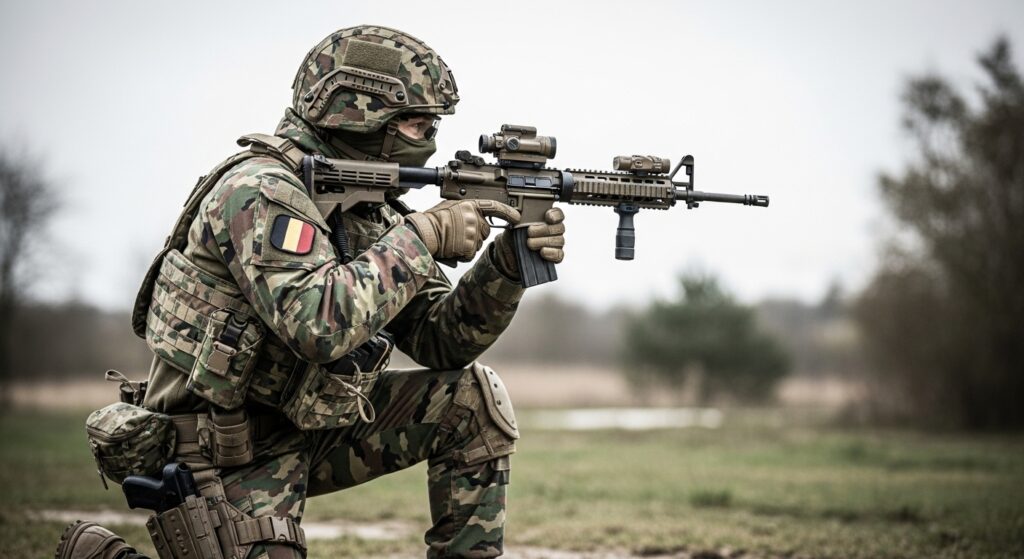
Modern warfare demands more than strength and strategy—it requires invisibility. Camouflage has evolved from simple patterns to highly engineered systems designed for diverse environments. Among these innovations, Belgian Multicam stands out as a cutting-edge approach to concealment, blending science, technology, and tactical design.
This article explores how Belgian Multicam is redefining military camouflage and enhancing operational effectiveness.
What Is Belgian Multicam?
Belgian Multicam refers to a camouflage pattern and system inspired by the widely recognized MultiCam camouflage pattern, adapted to meet the operational needs of the Belgian Armed Forces.
It is designed to:
- Provide concealment across multiple terrains
- Reduce visual and infrared detection
- Enhance soldier survivability in dynamic environments
Evolution of Camouflage Technology
Camouflage has come a long way from traditional uniforms. Early designs focused on basic color blending, but modern systems incorporate advanced research from fields like:
- Material Science
- Optics
- Military Science
Belgian Multicam represents the next step in this evolution—combining visual deception with technological sophistication.
Key Features of Belgian Multicam
1. Multi-Environment Adaptability
Unlike single-terrain camouflage, Belgian Multicam is effective in:
- Forests
- Urban landscapes
- Arid regions
Its gradient color transitions allow it to blend seamlessly into varied surroundings.
2. Advanced Color Palette
The pattern uses a mix of:
- Greens and browns for vegetation
- Beige tones for dry terrain
- Subtle shading for depth perception
This layered design reduces visibility at both short and long distances.
3. Infrared Signature Reduction
Modern detection systems often rely on infrared imaging. Belgian Multicam incorporates materials that minimize heat signature, making soldiers less detectable by night-vision technologies.
4. Lightweight and Durable Fabric
Uniforms featuring Belgian Multicam are built for:
- Comfort during long missions
- Resistance to wear and tear
- Breathability in extreme conditions
Comparison with Traditional Camouflage
| Feature | Traditional Camouflage | Belgian Multicam |
|---|---|---|
| Terrain Adaptability | Limited | High |
| Pattern Complexity | Simple | Advanced |
| Infrared Protection | Minimal | Enhanced |
| Operational Flexibility | Low | High |
Real-World Applications
Belgian Multicam is utilized in various military contexts:
- Combat Operations: Enhancing stealth in hostile environments
- Peacekeeping Missions: Adapting to unfamiliar terrains
- Training Exercises: Preparing soldiers for diverse scenarios
Its versatility makes it a valuable asset in modern defense strategies.
The Role of Innovation
The development of Belgian Multicam reflects broader trends in military innovation. Companies like Crye Precision have paved the way for adaptive camouflage systems, influencing global military designs.
Belgium’s adaptation highlights how nations customize proven technologies to meet specific operational requirements.
Challenges and Considerations
Despite its advantages, Belgian Multicam faces certain challenges:
- Cost of production and distribution
- Need for continuous updates as detection technology evolves
- Balancing effectiveness across all environments
These factors drive ongoing research and development.
The Future of Camouflage Technology
Looking ahead, camouflage is expected to become even more advanced with innovations such as:
- Smart fabrics that adapt to surroundings
- Integration with wearable technology
- Enhanced thermal and digital concealment
Belgian Multicam is a stepping stone toward these futuristic solutions.
Key Takeaways
- Belgian Multicam is a modern adaptation of MultiCam technology
- Designed for multi-terrain effectiveness and stealth
- Incorporates infrared signature reduction
- Enhances soldier survivability and mission success
- Represents the future direction of camouflage innovation
FAQ’s
1. What is Belgian Multicam?
It is an advanced camouflage system used by the Belgian Armed Forces, based on Multi Cam technology.
2. How is it different from regular camouflage?
It works across multiple environments and includes infrared protection.
3. Who developed Multi Cam?
It was developed by Crye Precision.
4. Is Belgian Multi cam used outside Belgium?
Similar Multi Cam patterns are used by various militaries worldwide.
5. What makes it effective?
Its adaptive color palette, advanced materials, and multi-environment design.
Conclusion
Belgian Multicam represents a significant leap forward in military camouflage technology. By combining adaptability, durability, and advanced concealment features, it equips soldiers with a critical advantage on the modern battlefield.